
What is the “Matter” Protocol?
Author:深圳市磊科通科技有限公司
Click:
Time:2024-07-24 08:57:01
What is the “Matter” Protocol?
Matter is currently the most popular brand in the smart home sector. Following on the three giants that Apple, Amazon, and Google jointly launched, both domestic and international ones. Samsung, Philips, IKEA, Huawei, Aqara, ORVIBO, and TUYA all announced in a hurry that their own Matter products were being developed. Green Mi even made a public claim that seamless OTA will be supported by the two Zigbee gateways that are already in use as Matter gateways. Everyone has been saying "Matter," but it has finally gotten to the point where it's "No Matter, No smart home."
Why is Matter attracting so much attention?
Firstly, it signifies a significant collaboration among the industry giants, with the Big Three temporarily setting aside their individual ecological interests to develop standards together for the first time.
Secondly, the adoption of Matter means that devices supporting it can seamlessly connect with mainstream smart speakers (such as Alexa, Google Assistant, HomePod) and the majority of mobile phones (Android, iOS) on the market. This breakthrough has effectively dismantled more than half of the existing ecological barriers.
What exactly is Matter? How does it relate to Zigbee, Bluetooth, and Wi-Fi? What advantages does Matter offer and what value does it bring?
I will address these three questions in my discussion.
- 1 -
What is the Matter anyway?
On December 19, Apple, Amazon, Google, and the Zigbee Alliance collectively introduced CHIP (Connected Home over IP), a smart home internet protocol centered around IPv6. As its name implies, CHIP aims to standardize smart home connectivity using the IP protocol.
In May 2021, the initial version of this protocol standard was finalized and rebranded as Matter. This transition marked the protocol's official launch into commercial use. Since then, Matter has evolved beyond a mere connectivity standard to include an authentication system. Devices certified by the Matter Alliance can now seamlessly interconnect with each other.

Matter operates as a smart home interconnection protocol based on the IP protocol.
To gain a clearer understanding of Matter, let's examine it through the OSI Layer 7 network model. The OSI seven-layer network model is structured as follows, from highest to lowest: application layer, presentation layer, session layer, transport layer, network layer, data link layer, and physical layer.
For simplification, we can group the session and presentation layers together under the application layer, and consider the data link and physical layers as the bottom layer. Thus, we have the application layer, transport layer, network layer, and the bottom layer.
Understanding Matter within the context of the OSI network model involves analyzing its functionality across these layers.

The application layer in Matter utilizes TCP/UDP as the transport layer, IPv6 as the network layer, and ipv6-adapted protocols like Wi-Fi, Ethernet, and Thread as the bottom layer.
Now, let's explore what it means to be an Internet protocol based on IP addresses.
Matter operates as an application-layer protocol that relies on the transport layer, leveraging underlying protocols such as Wi-Fi, Ethernet, and Thread. Consequently, it is also referred to as Matter over Wi-Fi, Matter over Ethernet, and Matter over Thread.
Here's an analogy to illustrate:
The underlying protocols serve as the communication mediums—some people prefer face-to-face interactions, others use email, and some opt for phone calls. The application-layer protocol acts as the language used—be it Mandarin, English, or French.
However, if everyone communicates exclusively in their native language, the communication costs can be substantial.
Matter serves as the "universal English" within the smart home industry, where everyone communicates uniformly in English. This standardization minimizes translation costs and enhances overall communication efficiency.
- 2 -
Relationship between Matter and Zigbee, Bluetooth, and Wi-Fi
The connection between Wi-Fi and Matter is crucial—it represents Matter over Wi-Fi, highlighting a dependent relationship between the two technologies.
How does this impact Zigbee and Bluetooth?
Zigbee and Bluetooth, particularly BLE and Bluetooth Mesh used extensively in smart homes, are not inherently compatible with IPv6-based underlying protocols. For instance, Zigbee specifies its own required underlying protocols, dedicated network layer, transport layer, and application layer.
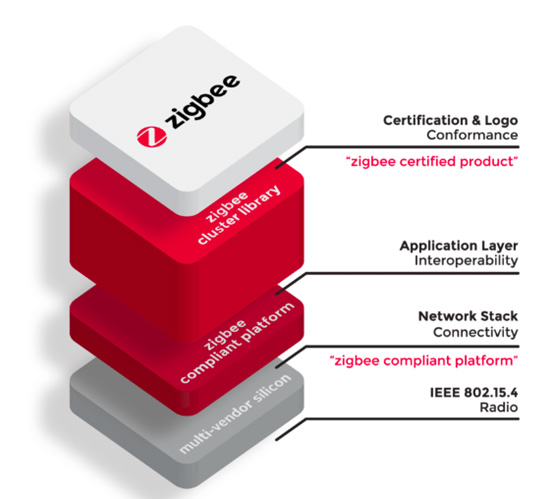
Unlike the OSI network model, Zigbee operates as a comprehensive protocol system. The Zigbee model can be represented as a combination of Wi-Fi, IPv6, TCP/UDP, and Matter.
Due to this, Matter and protocols like Zigbee or Bluetooth are mutually exclusive and cannot coexist. Therefore, there won't be implementations like Matter over Zigbee or Matter over Bluetooth.
For Zigbee, Bluetooth, and other non-Matter protocol devices, how can they support the Matter protocol?
Non-Matter devices can be integrated with Matter-enabled devices through a gateway for protocol conversion.
- 3 -
The value of Matter
The Matter protocol combines Apple's HAP Security framework, Google's Weave device operation mechanism, and Zigbee's physical model. These three core elements synergize their strengths to establish a comprehensive protocol.

Therefore, Matter leverages the strengths of three core forces:
- Apple HAP Security ensures robust privacy and security with end-to-end communication and local network control. User data remains stored within devices and is transmitted securely between them. It supports various pairing methods like Bluetooth, QR codes, and NFC, enhancing user experience.
- Google Weave provides standardized authentication mechanisms and device operation commands, ensuring stable interoperability across different devices.
- Zigbee's Physical Model offers proven device attribute models that effectively meet device capability requirements. With a large developer community, Zigbee enables rapid and cost-effective development of Matter applications.
Advantages include strong security, enhanced user experience, reliable stability, and reduced development costs.
What value does Matter bring?
- For users: Simplifies control by allowing one app to manage all Matter-compatible devices, regardless of manufacturer. Provides freedom to choose products based on personal preference.
- For manufacturers: Eliminates the need to develop proprietary protocols, focusing efforts on product innovation and functionality enhancements.
- For service providers: Streamlines procurement and operational costs by supporting a wide range of manufacturers. Enables service providers to concentrate on building service capabilities for enhanced customer satisfaction.
Final thoughts:
The industry is optimistic about Matter's advancement, but uncertainties and challenges remain. Memories of Zigbee 3.0's setbacks linger, prompting concerns about whether Matter can truly achieve the vision of a connected world.
Prev : Discovering the Range of Bedroom LocksNext : What smart home products currently support the "Matter" protocol?
Wish your recommendation.
YouArticle
已有49人推荐
文章推荐

